
The trips we don’t see: Rethinking regional transport
The journeys that never happen tell the story we’ve been missing. Drawing on her presentation at the 2026 Transport Australia Conference, Mary Haverland challenges conventional transport thinking by revealing how unseen, abandoned journeys expose deeper issues of access and inclusion in regional communities.
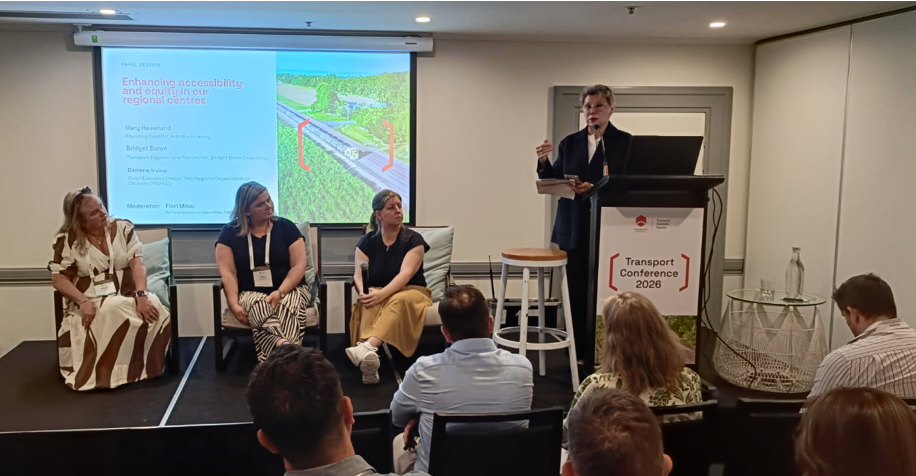
2026 Transport Australia Conference, Cairns
At the 2026 Transport Australia Conference in Cairns, Avandra’s Mary Haverland challenged a long‑held assumption at the heart of transport planning: that what we measure reflects what matters. In regional Australia, many of the most important journeys never appear in the data, they are the trips people abandon before they even begin. This article is a summary of Mary’s presentation, The Trips We Don’t See: Rethinking Regional Transport, which explores why these invisible journeys reveal a deeper truth about access, inclusion and opportunity, and why it is time to rethink how we design transport systems for regional communities.
For decades, transport planning has focused on the trips we can count. Commuter flows. Traffic volumes. Freight movements. But the most important journeys in regional Australia are often the ones that never happen.
Every day, people cancel trips before they even begin. The medical appointment that is too hard to reach. The training course that requires three connections. The social visit that simply isn’t worth the effort. These trips never appear in our data, yet they tell us more about transport disadvantages than any patronage report ever could.
Regional transport is not metropolitan transport with fewer people. Demand is dispersed, irregular and tied to everyday life journeys for healthcare, education, shopping, family and community connection. Yet we continue to apply city-based solutions to fundamentally different challenges.
The real issue is not a lack of transport services. It is a lack of integration. Across regional Australia we already have public transport, school buses, community transport, health transport and informal lift-sharing networks. The problem is that they usually operate in separate systems which are difficult to coordinate, integrate or even find information about.
For regional communities, the challenge is rarely speed. It is access. People are not asking for a bus or a train every ten minutes. They are asking for reliable, flexible ways to get where they need to go when they need to get there.
The need for change is only becoming more urgent. Across regional Australia, 22% of residents are aged over 65 and 5.1% of households do not have access to a car (which in the regions often means having no access to transport at all), increasing demand for flexible transport options and alternatives to driving. At the same time, remote work, telehealth and online education are creating new opportunities for regional communities to grow and diversify. But those opportunities depend on people being able to access services when physical travel is still required.
The good news is that the tools already exist. Real-time information, digital booking platforms, demand-responsive transport and coordinated service planning make it possible to connect existing regional services into a seamless mobility network.
International experience shows what is possible. From The Netherlands to Scotland, Norway and Japan, successful regional mobility systems are designed around access outcomes, not transport modes. They harness digital connectivity to provide physical connectivity. This is why these programs often become part of the transport system; while in Australia, they remain pilots.
Perhaps it is time we changed the way we measure success. Instead of patronage and cost per trip alone, we should be asking: Can people in our regional communities’ access healthcare? Can they reach education? Can they stay connected to work, family and community? What services do we already have and do people know about them?
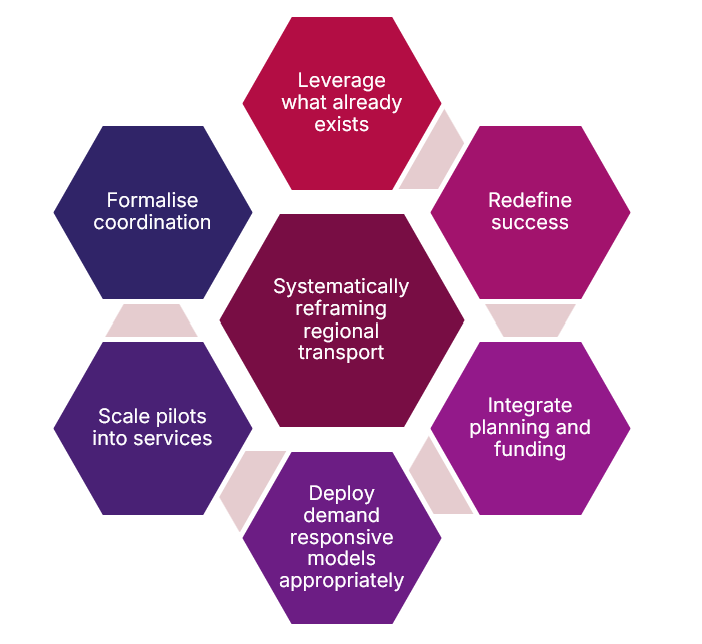
Reframing regional transport
The future of regional transport is not about moving faster between cities. It is about making sure people can get where they need to go, at all times. That requires a shift from planning individual services to designing connected systems around people’s lives.
We’re missing many trips in our data, so they don’t show up in the usual transport evidence base, but they clearly point to the need for a new conversation about transport in regional Australia.